
Importance of Solvent Systems in Pharmaceutical Pellets Coating
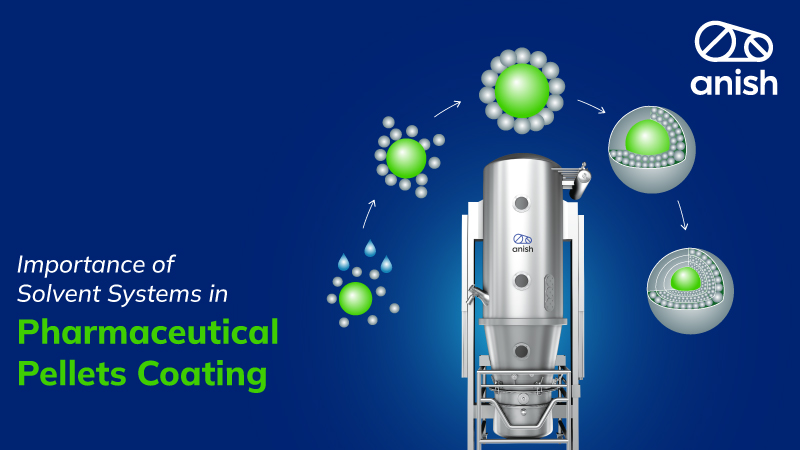
A solvent is a critical processing aid that must not be present in the finished product. However, without a solvent, pellets cannot be produced. In other words, it is an element whose presence in the final product can affect product quality, but without which the product cannot be formed.
A solvent, or a combination of solvents, referred to as a solvent system, plays a crucial role in pellet manufacturing. The solvent system directly impacts film formation, coating solution viscosity, drug release behaviour, drying time, equipment process parameters, and overall product quality.
There are three types of coating systems based on the solvent system:
- Aqueous coatings: Water is the solvent.
- Organic Coatings: Here, the solvents are organic liquids – Isopropyl alcohol, Ethanol, Methanol, Acetone, Methylene dichloride.
- Hydro-Organic coatings: Here, the solvent system is in combination with Water-Acetone, Water-Methanol, Water-Ethanol etc. This combination of solvent coatings comes under Hydro-Organic or Hydro- alcoholic coatings.
Role of Solvent systems in Pellets coating:
The primary function of a solvent is to dissolve or disperse the polymers or binders or Active drug or colorants, or drug release impacting materials and allow them to substrate surface. Hence, based on the solvent system selection, the following parameters have a predictable impact on pellet manufacturing.
- Visual appearance: This stage is the last step of pellet manufacturing, where we can coat different colors on the final pellets to enhance the patient’s visual acceptance when filled in transparent hard gelatin capsules. Generally, at this stage, aqueous solvent, i.e., water, is the preferred aid where the desired color and HPMC E5 or PVP K-30 are dissolved in water to get the desired color solution.
- Film formation: The entire product performance depends on this film formation only. Generally, on the inert spheres, there are rough surfaces or small pores like apertures may present, to smooth those surfaces, seal coating should be performed with water as a solvent and HPMC E5 or PVP K-30 as a binding material. After this coating, inert spheres will achieve proper spherocity. The strength of the film is achieved with the help of plasticizer, and these plasticizers, in general, are dissolved in organic solvents.
- Drug release mechanism: This mechanism entirely depends on the type of solvent and the nature of the polymer. Generally, the maximum of the pellet dosage forms are controlled-release dosage forms with enteric coatings, where the drug release will be at intestinal pH. Here, generally Eudragits or HPMC Phthalates are used; these should be dissolved in organic solvents like Acetone, Methanol, Ethanol, along with the plasticizer. In a few cases, two or more organic solvents are mixed with 5% of water to maintain the hygroscopicity inside the equipment or to reduce the static nature generated through organic solvents.
- Viscosity: The viscosity of the coating solution should impact the spraying behavior or probability of the solution, and this phenomenon completely depends on the type of solvent. Generally, water has a more viscous nature compared with organic solvents.
- Drying time: Based on the type of solvent, the drying time of the pellets at different stages of coating will change, if the coating is water based coating we need to keep more drying time when compared with organic solvents.
- Generation of Static charge: This stage arrives when coatings performed with only organic solvents, due to lack of moisture presence inside the equipment or due to lack of water content in the coating solution static charges will generates, due to the generation static charges pellets will bind one over the other while fluidizing inside the FBC bowl, continuous coating on this pellets results in the formation duplets or triplets or lumps hence to avoid this situation need to add 5% water in the coating solution results reduce in static behaviour of the pellets.
- Plasticization: The addition of plasticizer is called plasticization. The only advantage of this plasticization is to increase the mechanical strength of the film and stability of the film. Generally, triacetin is used, and plasticizers are mixed in organic solvents.
- Optimization of Solvent: Generally, the solvent type should be selected based on the nature of API, polymers, binders, colorants, or desired drug release profile of the drug and the stage of coating, like Seal coating, drug loading, polymer coating, sub coating or color coating.
- Cost effectiveness: Generally, the product cost depends on each unit operation, which includes both material and machine, hence water should be the most usable solvent for product quality and product cost, whereas organic solvents needs to be purchased.
Anish Pharma, a world-class fluid bed manufacturer, provides precision-engineered solutions for superior pharmaceutical pellet coating. With cutting-edge technology, the company ensures uniform coating, controlled release, and unmatched efficiency in drug delivery.
Other Blogs
- Role of Preformulation Parameters in Pharmaceutical Dosage Forms Manufacturing
- Equipment Capacity and Airflow Management for Successful Fluid Bed Coating Scale-Up
- What is granulation? Why do we need it? And what’s the best place to carry it out?
- What is a Fluidized Bed Dryer?
- The Heart and Soul of the Pharmaceutical Industry: Materials & Machines
- Temperature and Humidity: Critical Factors in Fluid Bed Processing
- Mastering Pellets Manufacturing: The Role of QTPP and QbD
- Guide to Optimal Fluid Bed Processor Selection: Key Considerations for Effective Material Processing
- Fluid Bed Performance Drivers
- Influence of Column Diameter and Partition Gap on Scale-Up of Bottom Spray Fluid Bed Coaters
- Critical Process Parameters Influencing Performance in Fluid Bed Systems
- Critical Factors for Scale-up in Bottom Spray Fluid Bed Coating
- Binders and Solvents in Granulation
- Types of Granulation in Pharma Manufacturing
- Granulation Techniques To Create Robust Formulation
- Unleashing the Power of Fluid Bed Technology: A Comprehensive Guide
- Pharmaceutical Pellet Production Techniques
- Pharma Granulation: From Powders to Perfect Granules
- Improving Productivity of Fluid Bed Processors
- Drug layering technique in pellet formation
- Drug delivery technologies in Pharmaceutical Formulations
- How to Choose the Right Pressure Shock Resistance (2 / 12 BAR) for Your Fluid Bed Processor