
Pharmaceutical Pellet Production Techniques
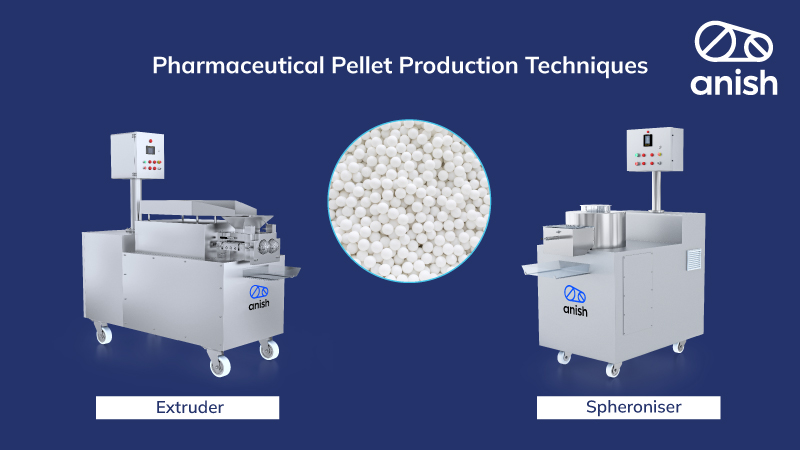
Pelletisation is the process of converting fine powders or granules of bulk drugs or excipients into small, spherical, free-flowing particles. In the era of advanced drug delivery systems, pelletisation stands out as a novel technique for extended, controlled, or delayed drug release. Pelletised dosage forms offer distinct advantages over traditional oral dosage forms, including excellent flow characteristics, prevention of dose dumping, site-specific drug delivery, and enhanced release of poorly bioavailable or short half-life drugs.
Technologies Involved in Pellet Manufacturing
Powder Layering
This technique involves depositing fine dry powders in regular layers and spraying a binder solution to bind the powder layers in a coating pan. Typically, centrifugal rotors, granulators, or traditional coating pans are used in this process.
Extrusion-Spheronisation
This method involves forming powders into extrudates or thread-like structures, which are then processed in a spheroniser to create spheres. Dry powders and actives are mixed in a rapid mixer granulator with binder solutions to form a wet mass. This mass is then extruded through a screen and spherical particles are formed in a spheroniser with rotating plates.
Cryopelletisation
In this process, droplets of a liquid formulation containing active ingredients are exposed to liquid nitrogen at -160°C. The rapid heat transfer solidifies the droplets into pellets, which are then dried in freeze dryers to remove water or organic solvents.
Balling
This technique involves continuous rolling and tumbling of dry powders in a rotating pan, with liquid spraying to form pellets. This is typically done in conventional coating pans.
Hot Melt Extrusion
Dry powders are pumped through a rotating screw at elevated temperatures and forced through a die to form uniformly shaped spheres.
Freeze Pelletisation
A molten-solid matrix is introduced as droplets into an immiscible liquid column, where the molten solid solidifies into pellets.
Spray Drying
This technique is used for drugs with poor bioavailability to improve drug release. A drug solution or dispersion is sprayed into a hot air stream, forming spherical particles.
Spray Congealing
In this method, drugs are melted or dissolved in hot melts of gums, waxes, or fatty acids. This dispersion is then sprayed into hot air or other gases below the melting point to produce spherical congealed pellets.
Advantages of Pharmaceutical Pellets
Pellets are commonly filled into hard gelatin or HPMC capsules or compressed into disintegrating tablets. When intended for oral use, pellets release their contents quickly in the stomach, distributing throughout the gastrointestinal tract for maximal absorption and reduced local irritation. The advantages of pelletised dosage forms include:
- Improved aesthetic appearance of the product.
- Controlled release rates through polymer coatings.
- Enhanced drug distribution, dissolution, and absorption due to the large surface area.
- Ability to combine chemically incompatible substances into a single dosage form.
- Excellent flow properties and flexibility in formulation and manufacturing.
- Effective taste masking.
- Prevention of agglomerate formation.
- Safety in handling, reducing risks associated with dust explosions and health hazards.
- Consistent shape and weight for improved product appearance.
Equipment Used in Pellet Manufacturing
- Coating Pans
- Various Mesh Sizes (Screens)
- Extruders and Spheronisers with different screen diameters and rotating plates
- Spray Dryers
- Fluid Bed Coaters
- Centrifugal Rotors
- Rapid Mixer Granulators
- Spraying Pumps
For advanced pellet manufacturing solutions and to optimize your manufacturing processes, reach out to anish pharma. We offer cutting-edge technology and expertise to elevate your production capabilities.
Other Blogs
- Role of Preformulation Parameters in Pharmaceutical Dosage Forms Manufacturing
- Equipment Capacity and Airflow Management for Successful Fluid Bed Coating Scale-Up
- What is granulation? Why do we need it? And what’s the best place to carry it out?
- What is a Fluidized Bed Dryer?
- The Heart and Soul of the Pharmaceutical Industry: Materials & Machines
- Temperature and Humidity: Critical Factors in Fluid Bed Processing
- Mastering Pellets Manufacturing: The Role of QTPP and QbD
- Importance of Solvent Systems in Pharmaceutical Pellets Coating
- Guide to Optimal Fluid Bed Processor Selection: Key Considerations for Effective Material Processing
- Fluid Bed Performance Drivers
- Influence of Column Diameter and Partition Gap on Scale-Up of Bottom Spray Fluid Bed Coaters
- Critical Process Parameters Influencing Performance in Fluid Bed Systems
- Critical Factors for Scale-up in Bottom Spray Fluid Bed Coating
- Binders and Solvents in Granulation
- Types of Granulation in Pharma Manufacturing
- Granulation Techniques To Create Robust Formulation
- Unleashing the Power of Fluid Bed Technology: A Comprehensive Guide
- Pharma Granulation: From Powders to Perfect Granules
- Improving Productivity of Fluid Bed Processors
- Drug layering technique in pellet formation
- Drug delivery technologies in Pharmaceutical Formulations
- How to Choose the Right Pressure Shock Resistance (2 / 12 BAR) for Your Fluid Bed Processor